
Local Targeting
Not Every Click Is a Good Click.
5 min read
Every click on your ad costs you money. That part is simple. What trips up most local businesses is the assumption that follows it — that more clicks must mean more customers.
They don't. A click from someone forty miles away who will never drive to you costs exactly the same as a click from someone three miles away who needs you today. Your budget can't tell them apart. Your targeting has to.
Distance changes what a click is worth
For a business people physically visit, or one that sends a van out, distance is the single biggest factor in whether a click can ever become revenue. Someone searching from across the state might be curious, might be comparing prices, might have mistyped. What they almost certainly aren't is your next customer.
This is why a national approach fails a local business. The ad gets shown widely, the click numbers look healthy, and the phone doesn't ring. The budget went to an audience that was never able to buy.
What location targeting actually does
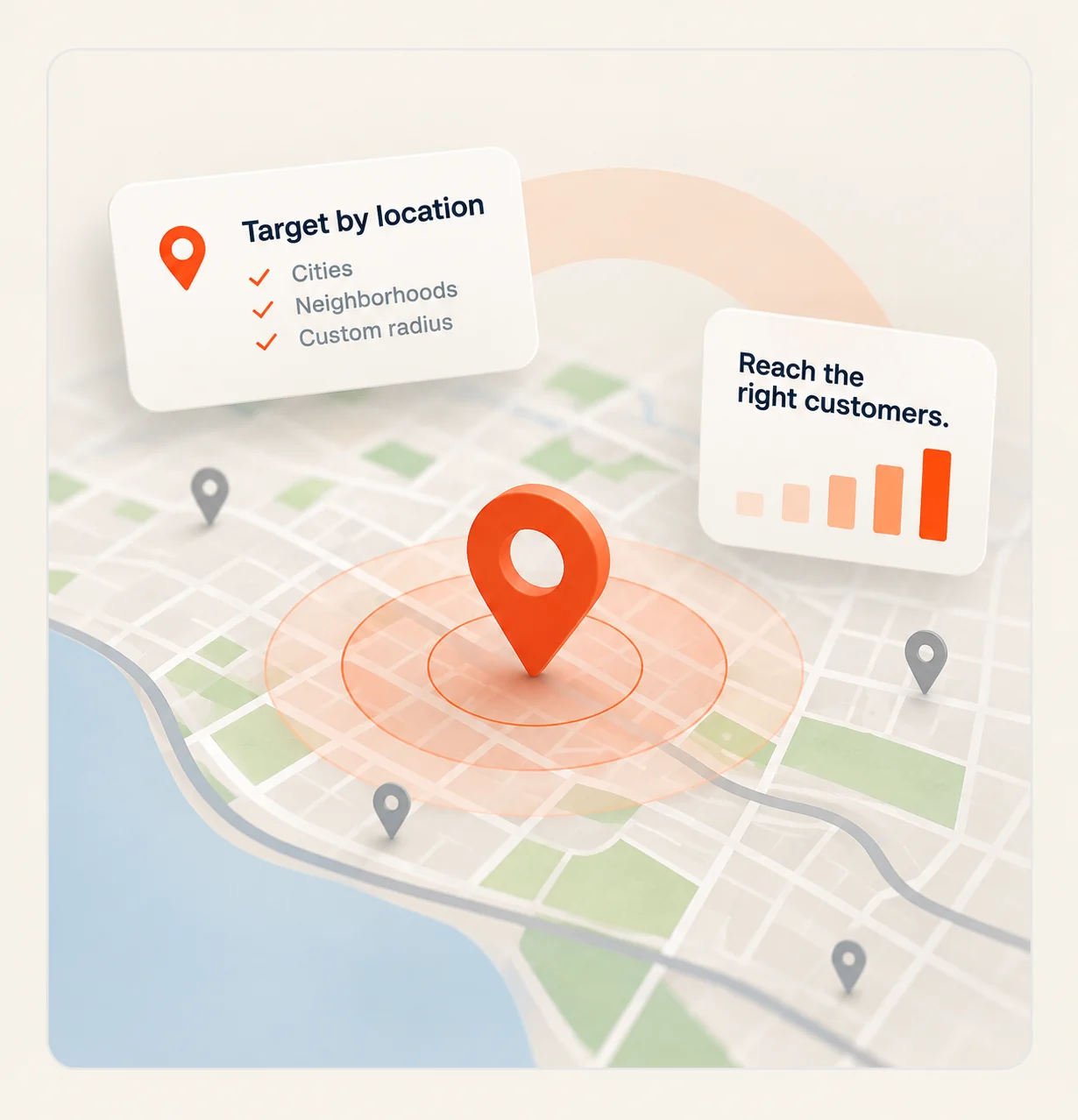
Google lets you draw a boundary and only show your ads to people inside it. That boundary can be a radius around your address, a set of zip codes, or specific cities and neighborhoods.
The right shape depends on how your business works, not on a rule of thumb:
- A restaurant or salon draws from a tight ring — people won't cross a city for a haircut.
- A plumber or electrician covers a service area, which may be lopsided rather than circular.
- A specialist people travel for can afford a wider net, because the trip is worth it to them.
- A business on the edge of a metro area often needs an off-center radius, not one centered on its own front door.
The setting most people get wrong
Google offers a choice between showing ads to people who are in your area, and showing ads to people who are merely interested in your area. The second sounds harmless and quietly widens your reach to anyone who mentions your city from anywhere in the world.
For most local businesses, the tighter option is the correct one. Someone in another state reading about your town is not going to book you.
Smaller and sharper beats bigger and vague
When a budget is modest — and most local budgets are — spreading it across a wide area means showing up faintly everywhere and strongly nowhere. Concentrating the same money on the area you can actually serve means showing up consistently for the people who can actually hire you.
It feels counterintuitive to reach fewer people on purpose. It's usually what makes a small budget work.
The goal was never more clicks. It's more clicks from people close enough to become customers.